
I made a challenge for myself this month, and the good news is that is does NOT involve creating a brand-new course, designing 17 new digital products, or suddenly posting 5 TikToks before lunch. 😂
Want to take the challenge with me?? If YES... read on!
We're going to go digging through the back of our digital closet and find one old product that deserves another chance.
Maybe it is a back-to-school resource that used to sell well on Teachers Pay Teachers. Maybe it is a mini-course people loved, but you stopped mentioning. Maybe it is a service that used to bring in reliable sales before you got distracted by a newer, shinier offer. We all have at least one of these sitting around somewhere, quietly collecting digital dust while we convince ourselves the answer must be to create something new.
For me, it's my Funnel Builder: Welcome Sequence! I sold 128 of these back in 2025, and it's still very relevant today. (And an awesome product if I do say so myself!)
Inside this product, business owners can download templates with AI prompts to fill in the template with their own voice. In just an hour or two (or LESS honestly)... they have a fully-built, strategic welcome sequence for their email list!
Each template is carefully designed to get your new leads excited and ready to buy from you. AND the best part is that with the AI prompt, no one will know you used a template. It comes out different every time, while still using the tried-and-true formula!
(See what I did there?! Here's the link & a 50% off code!)
This month, we're going to resist that urge to put our energy toward the next newest thing. (Especially if you're feeling the FOMO because one of your "competitors" made something new and exciting...)
We're going to pick one old product, put consistent effort behind it for one solid month, and see what happens. Your goal can be $1,000, but the bigger goal is proving to yourself what focused attention can do.
Hint: This challenge is not really about reviving an old product. It's not even really about making $1,000.
It is about focus.
Step 1: Choose the right product
The first rule is that you can only choose one.
I know. Rude.
But the entire point is to stop splitting your attention between five offers, four platforms, and the new idea you had while brushing your teeth this morning. (Guilty!! 👋)
Choose something that converted well in the past, even if “the past” was several years ago, and make sure it makes sense for this time of year.
An old back-to-school resource could be perfect for August. A mini-course that helps teachers get organized might make sense right now. A service that solved an urgent seasonal problem could also be worth bringing back.

Look at what people used to buy, ask about, or respond to. You're not looking for the product you feel most emotionally attached to. (Also guilty! 👋) You are looking for evidence that people wanted it.
Price is important here, too. We're reverse-engineering our way to our goal.
If you have not engaged your audience in a while, a product between $20 and $100 may be easier to revive than a high-ticket offer that requires a lot more trust.
At $20, reaching $1,000 means 50 sales. At $50, it means 20. At $100, it means 10.
None of those numbers are guaranteed, of course, but they give you something concrete to work toward instead of vaguely hoping the internet remembers you exist. 🙈
Step 2: Pick your traffic plan
Once you have chosen the product, your next job is to get people looking at it.
Start by asking yourself two questions: What has worked for me before, and what kind of marketing do I actually enjoy doing?
For me, Instagram Stories have historically brought in more engagement than Reels. I can talk through an idea, share behind-the-scenes thoughts, ask questions, and naturally lead into an offer without spending three hours choosing audio and wondering what the cool kids are doing on IG these days.
For me, (and please hold me to this)... I'm going to commit to talking about the product in Stories once a week while creating related content throughout the month. The related content could answer questions, address common problems, share quick wins, or show how the product helps.
You have a few ways to approach this. ⬇️
You could choose a platform that has already performed well for you and go all in on that topic for one month. You could choose a platform you have not tried and treat the month as an experiment. Or, if you have more time, you could test two or three platforms and compare what happens.
There is only one promise I want you to make before you begin: if a platform does not work, we're going to let it go without guilt.
If you decide to try TikTok and it brings you zero clicks, zero sales, and one comment from your cousin, you can stop creating on TikTok for a while. That doesn't mean you failed! You experimented, and you collected information.
Marketing is experimental. You try something, watch what happens, and adjust. Somewhere along the way, we started treating every unsuccessful platform like a personal rejection, when really it is just data wearing an annoying little hat.
Step 3: Email your list
This part is non-negotiable.
If you have an email list, promote the product during August. Once a week is enough, especially if you are providing useful education along with the offer.
You do not need to send four emails that all say, “Buy this now.” Actually, please don’t. 😂
➡️ Use the framework we have talked about before: connect, teach, sell.
Start by making a connection through a story, a question, or a problem your reader recognizes. Then teach them something useful that helps them make progress. Finally, show them how your product helps them take the next step.
For example, if you are selling a back-to-school resource, you might tell a story about the first week of school, teach a simple strategy for making routines easier, and then introduce the product as a way to put that strategy into practice.
Especially if you haven't talked to your people in a while, it's important to provide value and sell in the same email. (But also... useful content does not mean hiding your offer at the bottom in six-point font like you are embarrassed by it.)
People joined your list because they wanted to hear from you. Let them know what you have that can help!
Another great thing you can do? Add this product to your welcome sequence! You can use these emails to sell your product now AND keep them in your welcome sequence so new people on your list always have an opportunity to buy one of your best-sellers while they're still warm!
Oooh, and don't forget you're getting 50% off on my Welcome Sequence templates!
Thinking I'm out of my mind?? Here are a few numbers from teacher biz owners who made $$ in one month by focusing on ONE product and an email sequence for that product. 🤯
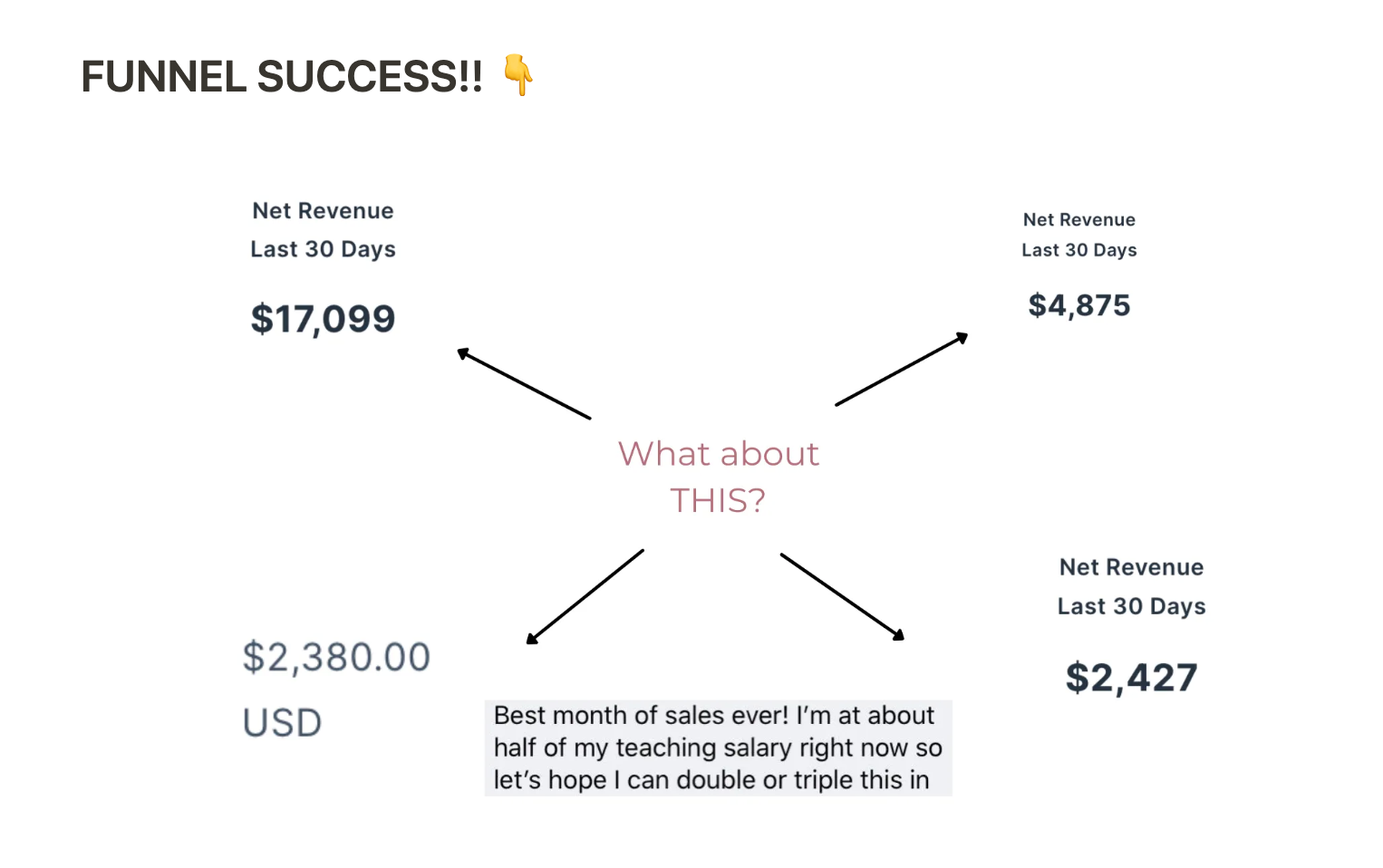
The size of your list will directly impact your results (plus how much you've been engaging with them AND if they're the right kind of subscribers), but you can see it's entirely possible.
And if this works... you can put that email sequence on autopilot. You've proved something important, and we'll want to repeat it!
Already have a welcome sequence in place? You can also jump into the full Funnel Builder program for more plug-and-play, proven email sequence templates that will make it easy-peasy to provide value AND sell without being totally awkward. There's even a full training on the $1000 challenge inside! And yes, I'll extend that 50% offer for the full program too!!
Step 4: Look for signals
Let’s say you promote the product for a few weeks and nothing happens.
First, please don't immediately decide your business is over and begin researching other business ideas. 😂 We're gathering information, remember?!
If the product isn't selling, try offering a related freebie instead. This can help you determine whether people are still interested in the topic, even if they are not ready to buy the offer in its current form.
Are they clicking? Downloading? Replying? Asking questions? Joining the list?
➡️ Those are signals.
Maybe the topic is strong, but the offer needs to be repositioned. Maybe the product page needs work. Maybe the price is too high for a cold audience. Maybe you need to rebuild trust before asking for the sale.
Not selling does not automatically mean the idea is bad. Sometimes it simply means you are one step earlier in the process than you thought.
A quick note about ads
Ads are working well for many businesses right now, so if paid traffic is already in your skill set, you could also test a small campaign to this product.
I wouldn't recommend throwing money at an offer that has never converted or a sales page nobody understands. But if this is something people have bought before, a small ad test could help you get fresh eyes on it and give you more data.
Again, experiment!
You're not signing a lifelong contract with Meta. (Thank goodness..) You're running a test.
Your challenge for August
➡️ Choose one product.
➡️ Choose your traffic plan.
➡️ Email your list once a week.
➡️ Track what happens.
At the end of the month, we're going to look at more than just the final sales number. Look at clicks, replies, downloads, conversations, and the type of content that got people interested.
Maybe you make $1,000. Maybe you make $300. Maybe you make no sales but discover that 150 people still want help with the problem your product solves.
All of that is useful!
The important part is that, for one month, we stop scattering our attention across everything you could be doing and put real effort behind one thing that already exists.
Oftentimes the next $1,000 is not hiding inside a brand-new product.
Maybe it's sitting in an old folder, waiting for you to talk about it again!




Responses